
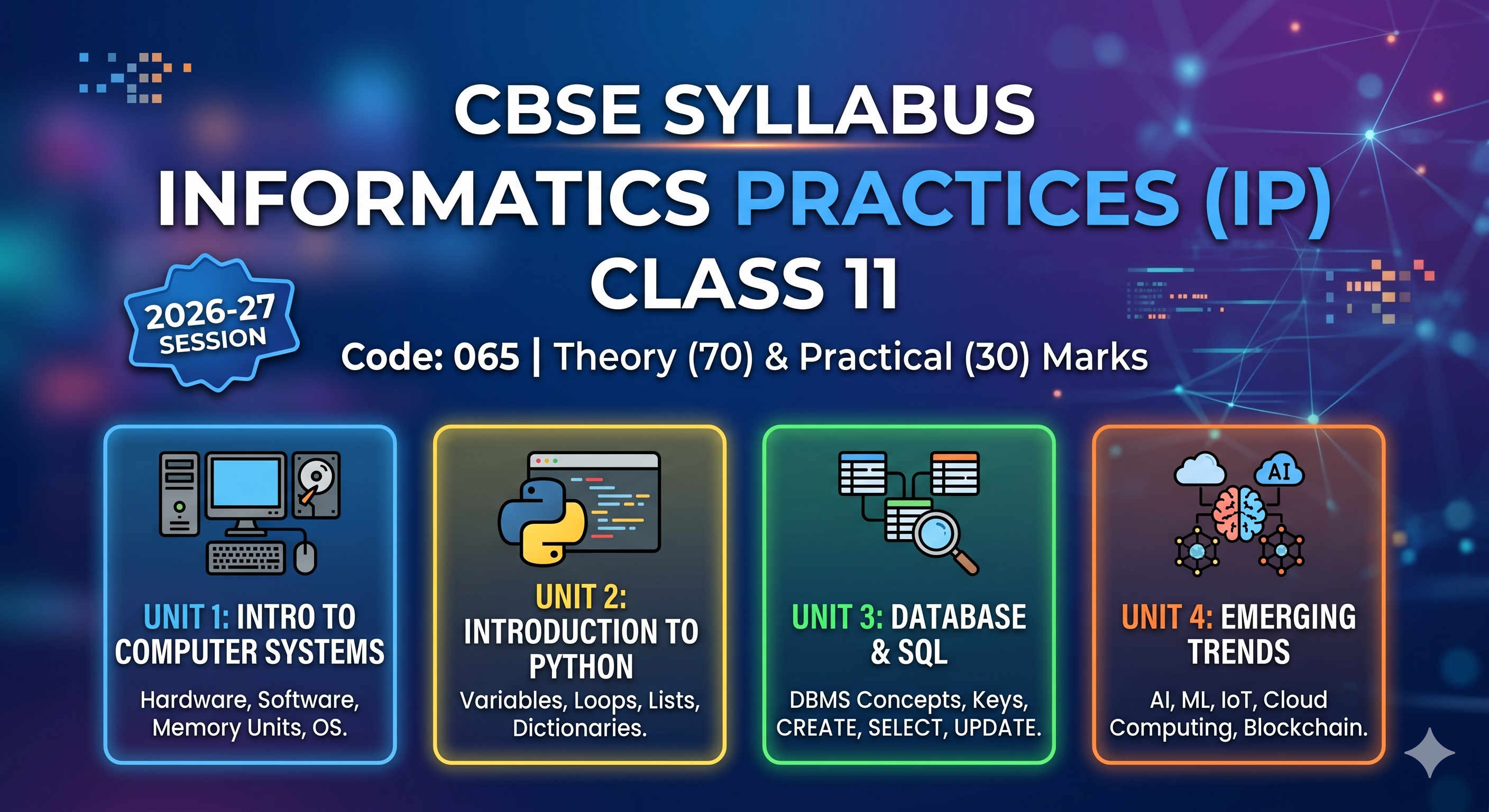
SS - Com - C11 - Informatics Practices (Code: 065)
The CBSE Informatics Practices (Code: 065) syllabus for Class 11 is designed to introduce you to the fundamentals of computing, data management, and the ethical use of technology.
The course is divided into 70 marks for Theory and 30 marks for Practical assessment.
Theory Course Structure (2025-26 & 2026-27)
| Unit No. | Unit Name | Marks | Key Topics |
| Unit 1 | Introduction to Computer System | 10 | Hardware (CPU, I/O devices), Software types, Memory units, Operating System basics. |
| Unit 2 | Introduction to Python | 25 | Basics of Python, Data types, Operators, Control structures (if-else, loops), Lists, and Dictionaries. |
| Unit 3 | Database Concepts & SQL | 30 | DBMS concepts, Relational Data Model (Keys), and SQL commands (DDL, DML, Select queries). |
| Unit 4 | Introduction to Emerging Trends | 5 | AI, Machine Learning, NLP, IoT, Cloud Computing, Block chain, and Smart Cities. |
| Total | 70 |
Practical Marks Distribution
The practical component focuses on hands-on coding and database management.
| S.No. | Description | Marks |
| 1 | Problem Solving using Python | 11 |
| 2 | Database Queries using SQL | 7 |
| 3 | Practical File (Min. 14 Python programs & 14 SQL queries) | 7 |
| 4 | Viva-Voce | 5 |
| Total | 30 |
Key Learning Outcomes
-
Computational Thinking: Learning how to break down problems and solve them using Python logic.
-
Data Management: Using SQL to create, update, and retrieve information from databases.
-
Future Readiness: Understanding the impact of "New Age" technologies like Cloud Computing and AI on society.
Since you've previously mentioned an interest in using AI tools like Leonardo.Ai and Google AI Studio, you might find Unit 4 (Emerging Trends) particularly relevant, as it covers the foundational concepts behind the AI models you use for your professional projects.
This video provides a detailed breakdown of the Class 11 IP curriculum, explaining the transition from basics to data handling.
3 Students
Teacher:
System Administrator
